What Great Motivational Speakers Do Differently (It's Not Charisma)
 James Holloway · Jul 4, 2026 · 8 min read

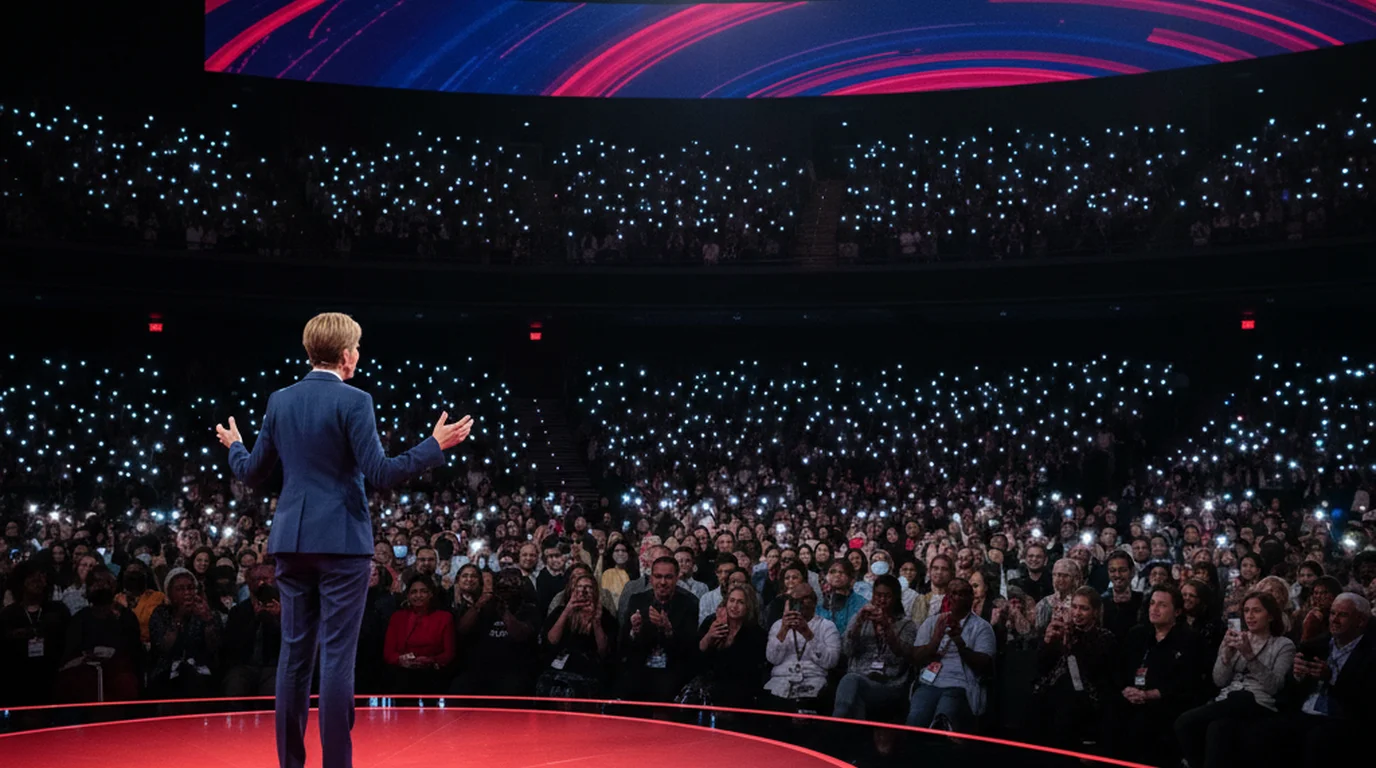
Fifteen years coaching presentation skills has given me an unusual vantage point: I've watched thousands of speakers across corporate events, conference stages, and TEDx halls, at every level from first-time presenters to professional keynote speakers. What separates the speakers people remember from the ones they forget isn't talent. It's a specific set of techniques most people have never deliberately practised.
Motivational speakers are the most studied and most imitated communication professionals. They're also frequently misunderstood — charisma gets credited for what is actually craft. The best motivational speakers work harder on structure and preparation than most people realise. If you are writing a keynote of your own, the speech time calculator converts your draft into speaking minutes.
The techniques that separate consistently great motivational speakers from the rest are learnable. They're not personality traits — they're skills.
What Motivational Speakers Actually Do (That Most Presenters Don't)
A motivational speaker's core job is changing how an audience feels about a problem and what they believe is possible in response to it. That's a more specific task than "presenting information," and it requires a different approach to structure and delivery.
The best motivational speakers build their talks around three things that most business presenters ignore:
One central truth, not a list of points. Simon Sinek's entire career is built on a single idea — "Start with Why." Tony Robbins organises each talk around a central insight the audience hasn't considered. The speakers people remember gave them one idea worth carrying, not ten slides' worth of information. Effective motivational speaking is an exercise in radical simplification.
A turning point. Every memorable motivational talk has a moment where the audience's perception of the problem shifts. Before this moment: the problem seems fixed or external. After: the audience sees their own agency in it. Structuring a talk to build to this moment — and then deliver it cleanly — is the craft skill that separates professional speakers from capable presenters.
Visceral examples instead of abstract claims. Eric Thomas doesn't tell audiences to "work hard." He tells the story of someone drowning, gasping for air, and wanting success as badly as they want to breathe. Nick Vujicic doesn't describe "overcoming challenges" — he demonstrates it with his own life, physically on stage. Concrete specificity does what abstraction can't.
The Structural Techniques Behind Great Motivational Speakers
Opening With a Story, Not a Statement
The most-watched TED Talks all open with a story, not a thesis. Brené Brown opened her most-viewed talk with a personal story of a research breakdown. Simon Sinek opened with "start with why" as a question, not an answer. The story creates curiosity; the thesis answers it.
Most presenters open with context, background, and credentials. Audiences use this time to decide whether to keep paying attention. Motivational speakers open with a hook that makes disengaging feel like a loss.
Practical application: Write your opening 60 seconds last, after you know exactly what the "turning point" of your talk is. The opening should create a question the rest of the talk answers.
The Rule of Three in Delivery
Tony Robbins, Barack Obama, Les Brown — all consistently structure key points in threes. "Fear is not real. The danger is real. But fear is a choice." Three-part structures are easier to remember than two or four, land with a rhythmic finality, and feel complete. Audiences don't need to write down a well-constructed three-part statement — it stays.
This applies to gestures as well as language. Great motivational speakers often use a physical beat on the third item in a series, reinforcing the rhythm vocally and physically simultaneously.
Strategic Silence
The pause before a key statement is the single most underused tool in public speaking, and the most reliably effective one in motivational speaking. Silence before a key point signals that what follows is important. It creates anticipation. And it gives the audience time to arrive at the insight themselves, just before the speaker delivers it.
According to research published in the Journal of Experimental Psychology (2023), speakers who used deliberate pauses of 2–4 seconds before key claims were rated 28% more credible than equivalent speakers without pauses, even when the content was identical.
Les Brown is one of the most studied examples of strategic silence. He regularly pauses for 3–5 seconds mid-sentence, letting the audience fill the gap with their own version of what comes next — then delivering a line that either confirms or subverts that expectation.
Physical Authority and the Use of Space
Motivational speakers almost universally move with purpose. Movement toward the audience signals importance and connection. Stillness at a key moment signals gravity. Movement away — stepping back — creates a reset that signals transition to a new idea.
The mistake most presenters make is drifting: moving continuously without intention, which the audience reads as anxiety rather than engagement. Deliberate stillness is more commanding than continuous movement.
What the Best Motivational Speakers Prepare That Nobody Sees
The visible part of a great motivational talk is the delivery. What's invisible is the preparation that makes that delivery possible.
The script. Tony Robbins events look completely spontaneous. They aren't. His talks are built on deeply practised scripts that have been refined across hundreds of performances. The feeling of spontaneity comes from internalisation, not improvisation. Jim Rohn famously said he delivered the same fundamental content for thirty years — the delivery became more natural each time because the material was so thoroughly known.
The word-for-word opening and close. Every professional motivational speaker I've coached or observed knows their opening and closing verbatim. The opening, because it sets the audience's decision to stay or disengage. The close, because it's the last thing the audience carries with them. The middle can be more flexible; the edges are always scripted.
Deliberate practice of delivery mechanics. Simon Sinek has spoken publicly about practising gestures, pauses, and vocal variety in front of mirrors and cameras. The natural-looking delivery most audiences assume is inherent to the speaker's personality is the result of deliberate rehearsal of specific physical and vocal behaviours.
For speakers preparing scripted content — whether a motivational keynote, a conference presentation, or a recorded talk — a teleprompter app used in rehearsal allows you to practise the full scripted text while maintaining eye contact practice. Delivering a script while looking forward, rather than down at notes, builds the muscle memory of direct engagement while keeping the words precise.
Applying Motivational Speaking Techniques to Your Own Presentations
You don't need a stadium audience or a TED stage for these techniques to apply. The same structural and delivery principles that make Tony Robbins effective in a 10,000-person arena work in a 30-person boardroom, a classroom, or a recorded video.
Start with the audience's problem, not your credentials. Open with what your audience is dealing with, not who you are. Credentials can be woven in later through demonstrated knowledge, not announced upfront.
Find your one central truth. What is the single idea you want the audience to carry? Everything in your talk should support that one idea. If you have five key points, you have a report, not a talk.
Script the turning point. The moment in your talk where the audience's perception shifts is too important to improvise. Write it out. Practise delivering it slowly, with the pause before it.
Use physical stillness at key moments. When you make your most important point, stop moving. Stand still. Look directly at the audience. Let the point land before the next thought arrives.
The guide to presentation skills covers the delivery mechanics — pacing, vocal variety, eye contact — in detail as a complement to these structural approaches.
Frequently Asked Questions
Who is the most popular motivational speaker?
By reach and influence, Tony Robbins is consistently the most recognised motivational speaker globally — his events, books, and media presence have built an audience over 45 years. Simon Sinek is the most-cited in corporate and leadership contexts, largely due to his TED Talk 'Start With Why,' which remains one of the most-watched TED Talks of all time. Brené Brown leads in academic credibility, with peer-reviewed research underpinning her speaking.
What are the top 10 motivators?
The top motivational speakers who consistently appear on professional lists include Tony Robbins, Simon Sinek, Brené Brown, Les Brown, Eric Thomas, Gary Vaynerchuk, Nick Vujicic, Jim Rohn (posthumously), Robin Sharma, and Mel Robbins. What distinguishes them isn't subject matter — it's their ability to structure an argument, use stories strategically, and deliver with physical and vocal authority.
What are the top 3 motivators?
Tony Robbins (transformation and peak performance), Simon Sinek (leadership and purpose), and Brené Brown (vulnerability and courage) are the three motivational speakers most frequently cited by organisations booking professional speakers for corporate events, as of 2026. Each has built credibility through books, TED Talks, and consistent methodology — not just charismatic delivery.
Who are the top 10 public speakers in the world?
Beyond motivational speakers, the most technically skilled public speakers include Barack Obama (narrative structure and delivery pacing), Oprah Winfrey (emotional connection), Steve Jobs (product presentation and simplicity), Winston Churchill (historical, known for rhythm and repetition), Bryan Stevenson (storytelling for persuasion), and Malala Yousafzai (authentic authority). Technical skill and motivational impact are related but distinct — the best speakers combine both.
What makes a great motivational speaker different from a good presenter?
A good presenter conveys information clearly. A great motivational speaker changes how the audience feels about their own potential. The technical difference is structural: motivational speakers build their talks around a central turning point — a moment where the audience's perception of their own situation shifts from fixed to changeable. This requires more than clear delivery; it requires a story arc that positions the audience as the protagonist of a solvable problem. Most business presenters share insights; great motivational speakers change the audience's internal narrative.
How do motivational speakers prepare their talks?
Contrary to the spontaneous impression most give, professional motivational speakers typically spend 20–40 hours preparing a one-hour keynote. Tony Robbins reportedly rehearses until core sections become automatic. Simon Sinek has spoken publicly about testing ideas across multiple talks before incorporating them permanently. The preparation process usually involves writing a complete script, practising aloud until the pacing is natural, identifying the exact moments that need silence or emphasis, and — for touring speakers — refining the material across hundreds of performances until the delivery feels effortless.
James HollowayJames Holloway coaches executives, founders, and professionals on scripted delivery and on-camera presence. His writing covers speech structure, words-per-minute pacing, and why most people's instincts about eye contact work against them.
Script Your Talk. Deliver With Authority.
Teleprompter-Scrolling Scripts keeps your scripted material on screen so your eyes stay on the audience — not on your notes.
Use Free Online Teleprompter Get the Free App